



Upgrading your RV battery bank is one of the most rewarding DIY projects you can undertake. Whether you are transitioning from standard lead-acid batteries to a high-capacity Lithium Iron Phosphate (LiFePO4) system or simply expanding your capacity to spend more time off the grid, a robust energy bank is the heart of your home-on-wheels.
When planning an upgrade, most of the focus naturally goes toward selecting the right batteries, sizing a massive pure sine wave inverter, or mounting high-efficiency solar panels. However, a critical piece of the puzzle is frequently overlooked: the heavy-duty electrical connectors that link everything together.
Using substandard connectors in a high-current DC system invites voltage drops, system inefficiencies, and even fire hazards. To ensure your electrical system operates safely and at peak efficiency, upgrading to heavy-duty Tinned Battery Lugs—often referred to universally as Marine Battery Lugs—is the single best choice you can make.
Why the Connection Quality Matters in an RV
An RV electrical system operates primarily on low-voltage Direct Current (DC), usually 12V, 24V, or occasionally 48V. In a low-voltage system, the current (amperage) required to run high-draw appliances like microwaves, air conditioners, or coffee makers is incredibly high. For instance, a 2,000-watt inverter running on a 12V system can pull over 160 amps of current.
When moving that much current, any resistance in the circuit acts as a bottleneck. Electrical resistance generates localized heat and causes a voltage drop, meaning your appliances receive less power and your batteries drain faster. The most common source of resistance in an RV electrical system isn’t the wire itself—it is the point of termination where the wire meets the battery post, busbar, or inverter.
The Danger of Bare Copper in Mobile Environments
Pure, bare copper is an excellent conductor of electricity, which is why it is used for high-gauge battery cables. However, copper has a major weakness: it is highly reactive to oxygen and moisture. Over time, bare copper undergoes oxidation, forming that familiar greenish-black layer of copper oxide.
Unlike copper itself, copper oxide is a terrible electrical conductor. As oxidation creeps into a battery lug and down under the wire jacket, it creates a high-resistance barrier. In an RV, this process is accelerated by several factors:
- Battery Off-Gassing: If you use flooded lead-acid batteries, they release corrosive acidic vapors during charging cycles.
- Environmental Exposure: RV battery boxes are often mounted externally on the travel trailer tongue or inside ventilated compartments open to road spray, humidity, and temperature swings.
- Vibration: Constant road vibrations can microscopically loosen weak physical connections, allowing moisture to seep into the gaps between the wire strands and the lug barrel.
What Are Tinned Battery Lugs?
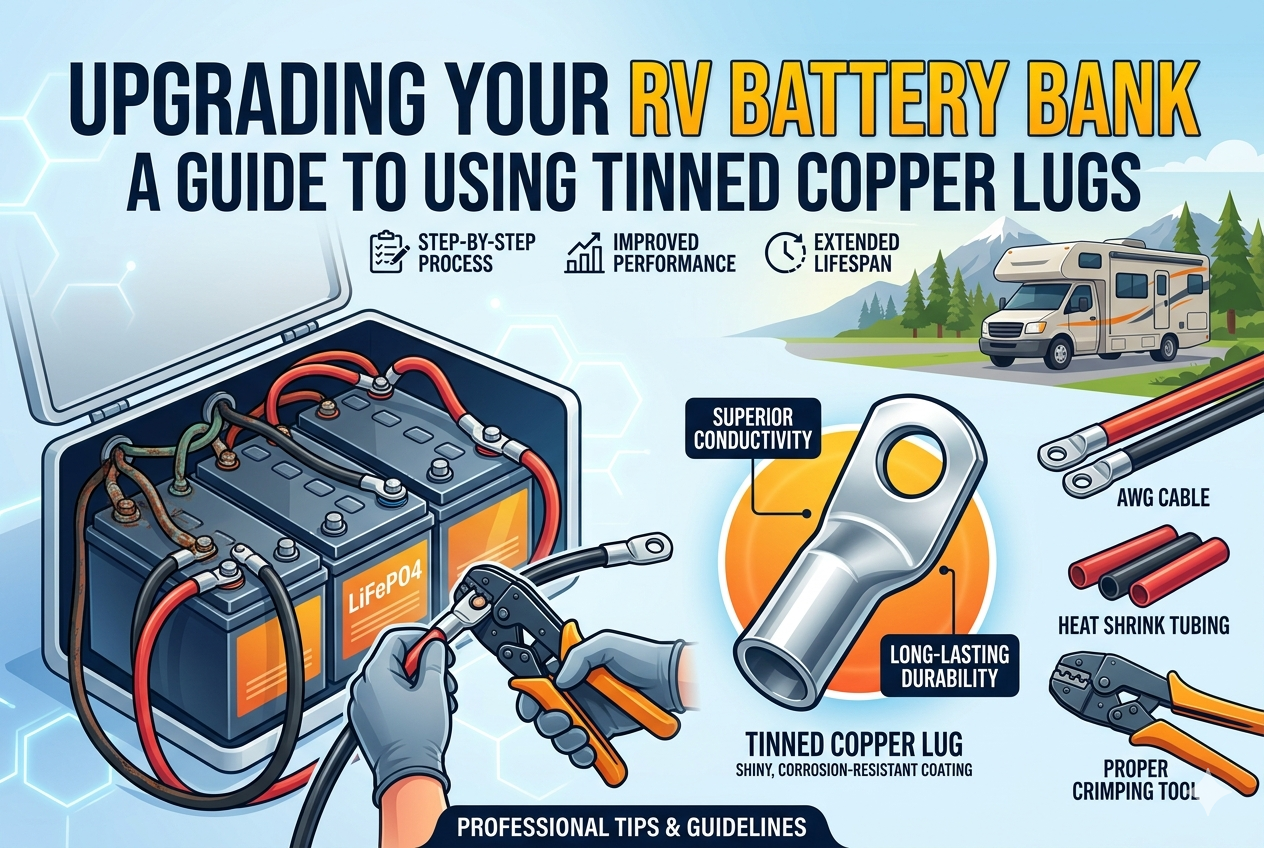
To combat oxidation, manufacturers take a high-grade pure copper lug and electroplate it with a micro-thin layer of tin. The result is a silver-colored connector that combines the elite electrical conductivity of copper with the immense corrosion resistance of tin.
Because tin does not oxidize easily when exposed to moisture, salt air, or corrosive gases, the underlying copper remains perfectly protected. This technology is so vital for harsh environments that these components are widely standardized as Marine Battery Lugs. If a connector is resilient enough to withstand the salt-heavy, completely saturated environment of a boat bilge, it will easily handle whatever your RV throws at it on the open road.
Key Benefits of Upgrading to Tinned Lugs
Upgrading your battery cables with tinned connectors provides several distinct advantages for your RV lifestyle:
1. Long-Term Reliability
Once you crimp and heat-shrink a tinned terminal onto your battery cable, the connection is essentially sealed against time. You won’t have to periodically remove the cables to scrape away green corrosion or replace degraded wires down the road.
2. Maximized System Efficiency
By keeping resistance near zero, your inverter receives the maximum possible voltage from your battery bank. This prevents premature “low voltage disconnect” alarms on your inverter when running high-load appliances.
3. Safer High-Amperage Charging
Modern RV lithium upgrades allow for incredibly fast charging rates, sometimes pushing 50 to 100 amps from a DC-to-DC charger or solar controller. Clean, tinned connections ensure these high currents do not cause dangerous thermal hotspots at your battery terminals.
Best Practices for Installing Your New Lugs
To get the most out of your Tinned Battery Lugs, the installation process must be executed correctly.
Choose the Right Size
Lugs are sized by two metrics: the wire gauge (such as 2/0 AWG, 4 AWG, etc.) and the hole diameter for the terminal stud (typically 5/16″, 3/8″, or 1/4″). Ensure a tight fit; the stripped wire should snugly slide into the barrel without forcing frayed strands outside of it.
Use a Heavy-Duty Mechanical Crimp
Never use standard hand pliers or a hammer to crush a heavy-duty battery lug. For high-gauge cables (4 AWG to 4/0 AWG), use either a hydraulic hex-crimping tool or a heavy-duty hammer-impact crimper. A proper mechanical crimp cold-welds the wire to the lug, compressing the metal until there are no air gaps inside the barrel.
Seal with Adhesive-Lined Heat Shrink
Even though the lug itself is tinned, moisture can still creep into the back of the barrel where the wire jacket ends. Slide a piece of dual-wall, adhesive-lined heat shrink tubing over the junction. When heated, the internal glue melts and creates a completely waterproof, airtight seal over the wire insulation and the lug barrel.
Conclusion
Upgrading your RV battery bank is an investment in your freedom and comfort on the road. Don’t let your high-end batteries or sophisticated solar system be throttled by weak links in the chain. By choosing heavy-duty Tinned Battery Lugs, you are opting for the same robust protection trusted in the marine industry. Spending a few extra dollars on quality Marine Battery Lugs gives you absolute peace of mind, knowing your electrical connections are safe, efficient, and built to last for miles to come.